News
last updated: 20-09-05
|
______________________________________________________________________ |
|
Soldier Arthur Foster re-interred in The Netherlands. |
|
|
|
Remains of private Arthur Foster found in Oosterbeek in 2003. |
|
|
|
|
|
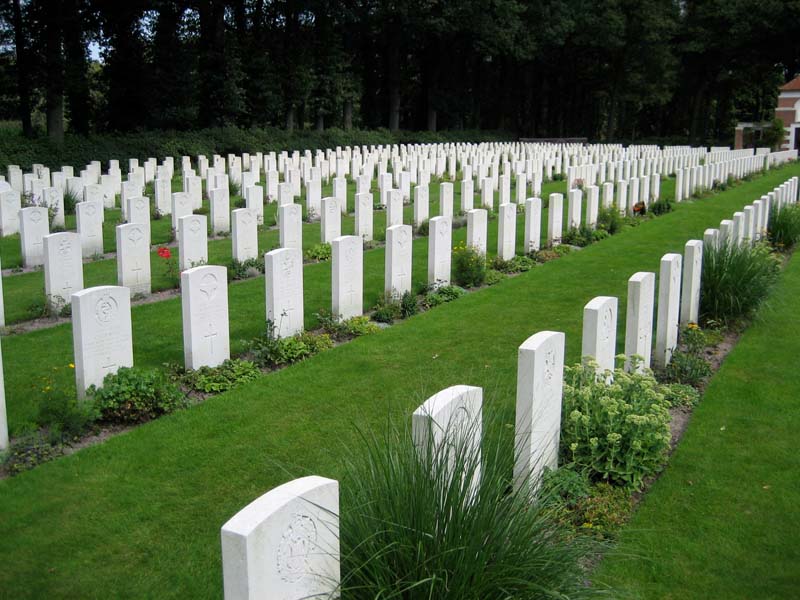
Re-interregation remains Arthur Foster at the Airborne Cemetery |
|
Oosterbeek 23rd March 2005. |
Foto's: Berry de Reus
Media Operations Telephone: 01980618264 18 February 2005 SECOND WORLD WAR SOLDIER TO BE RE-INTERRED IN THE
NETHERLANDS Sixty years after he was killed in action, Bolton
soldier pte Arthur Foster of The Border Regiment, will be re-interred at
Arnhem Oosterbeek War Cemetery in The Netherlands on Wednesday, 23rd
March 2005. The service will start at 11 OOhrs. pte Foster joined the Border Regiment at the
beginning of the war and was killed in action on 21st September 1944,
aged 27, when his Company position, overlooking the Rhine at the
Westerbouwing, was attacked by a large enemy force, which included
tanks. Workmen discovered his remains at the bottom of a former trench.
pte Foster was identified by the Dutch Army Recovery Team using
regimental dental records. The team is responsible for recovering the
remains of Service personnel killed in two world wars. After the war, pte Foster was one of 33 soldiers
from the Border Regiment with no known grave and who were commemorated
on the Groesbeek Memorial near Nijmegen. He is the fourth of these to
have been found over the last 12 years; Privates Ernest Ager and Douglas
Lowery were re-buried in the Oosterbeek Cemetery in 1993 and Corporal
George Froud in 1998. The service on 23rd March will be attended by pte
Foster's niece and her family. The Honour Guard and Firing Party will be found by
The 1st Battalion, the King's Own Royal Border Regiment who will bury
him with full military honours. The King's Division Normandy Band will
provide the music at the ceremony. NOTE TO EDITORS: 2. There will be a limited amount of time
available to speak to members of pte Foster's family after the
re-interment ceremony, if you would like to do so, please contact the
number below. Contact: Lynne Gammond, AG Media Ops, Upavon,
Wiltshire Tel: 01980618083 Fax: 01980618086 Mob: 07769887707 e-mail: mediaops@aghq.mod.uk Oosterbeek Cemetery The Kina's Own Royal Border Reaiment During WW2 the 1st Battalion served with the
British expeditionary Forces in France 1939-40 and was evacuated from
Dunkirk. In October 1941 it was converted to a glider-borne role in the
1st Air Landing Brigade of the new British 1st Airborne Division. After
training in England the Battalion moved to North Africa in May 1943 and
took part in the first ever Allied Glider landings on Sicily on 9/10
July 1943, when over half of the Battalions' Gliders were released too
early and crashed in the sea. After serving on Sicily and Italy the
Battalion returned home. After a number of cancelled operations in
the summer of 1944, the 1 st Airborne By 19th September they were defending the
perimeter from just north of the main road (the Utrechtseweg) in
Oosterbeek down to the Rhine. They fought against overwhelming odds
until the order to withdraw was given on the night of 25th September.
After nine days hard fighting, those fit to go made their way down to
the Rhine and swam or were ferried in small boats to the safety of the
southern bank. Medical staff and others remained behind with the wounded
and injured who could not be moved. Over 270 officers and men, many of
them wounded, made it to safety, nearly 400 were taken prisoner. 125
officers and men were killed during the battle, or later died of wounds
and sickness in POW camps. Private Arthur Foster was one of those
killed. Every year since the end of WW2, former
members of the 1 st Battalion The Border
Archive

ARMY
Headquarters Adjutant General's Command
Trenchard Lines, Upavon, Pewsey, Wiltshire, SN9 6BE
Fax: 01980618086
E-mail: mediaops@aghq.mod.uk
1. Those wishing to attend should contact the
number below as soon as possible to ensure appropriate media passes.
Oosterbeek lies 7 kilometres west of Arnhem on the road to Wageningen.
From the Utrechtseweg turn onto the Stationsweg, heading for Oosterbeek
Station. At the railway station turn right onto Van Limburg Stirumweg.
The entrance to the cemetery is a short distance along this road,
opposite the town cemetery.
Arnhem is one of the most famous of the Battle Honours carried on the
Colours of The King's Own Royal Border Regiment. This Battle Honour was
granted to the Border Regiment, which amalgamated in October 1959 with
the King's Own Royal Regiment (Lancaster) to form the present King's Own
Royal Border Regiment. The Border Regiment was formed in 1881 by the
amalgamation of the 34th Cumberland and 55th
Westmoreland Regiments of Foot, who became the 1 5t and 2nd Battalions
respectively.
Division took part in Operation Market-Garden, the landings on the River
Crossing in Holland in September. 1st Airborne Division were to land at
Arnhem, capture the main road bridge and other crossings over the River
Rhine and hold a defensive perimeter some 3.5 miles long along the
northern bank from Arnhem to the small town of Oosterbeek. The main
force took off on 17th September 1944. The role of the 1 st Battalion Border Regiment was to secure Landing and Drop zone areas to
the west of Oosterbeek. On the second day they were to move towards the
western side of Oosterbeek and provide the defence of the Division's
western perimeter.
Regiment and their families and friends have gone back to Holland to
attend the annual service of Commemoration at Oosterbeek and other
Commemoration events in and around Arnhem and Oosterbeek. Many veterans
made the effort to go in September 2004 for the 60th Anniversary, when
they also unveiled a plaque to the memory of their comrades who fought
and died during the Battle of Arnhem.